Overview of Ferry Operations Today
Golden Gate operates four passenger ferry routes across the San Francisco Bay connecting Marin and San Francisco, and one seasonal, special event service between Larkspur and Oracle Park with service to Giants baseball home games. Today, Golden Gate Ferry operates weekday and weekend/holiday crossings on the Larkspur, Sausalito, Tiburon, and Angel Island routes. Golden Gate Ferry does not operate on New Year’s, Thanksgiving, and Christmas days.
Headquartered in Larkspur, California, in central Marin County, under the direction of the Deputy General Manager for the Golden Gate Ferry Division, 90 employees are responsible for the operation of the ferry fleet. The workforce includes vessel masters (captains), operations supervisors, terminal agents, deckhands, mechanics, and storekeepers, in addition to supervisory and administrative personnel.
Each weekday, operations supervisors, terminal personnel, vessel masters, and crew arrive by 5:00 a.m. to prepare the vessels for departure. The team effort begins in the vessel’s power plant as operators conduct daily inspections of engines, generators, bilges, tanks, and other key systems. Deckhands replenish the water supply before double-checking the cleanliness of passenger areas. Vessel masters, working from the pilot house, receive updates on weather, tidal, and traffic conditions as terminal agents and operations supervisors begin greeting passengers.
By 5:45 a.m., the first of many trips across San Francisco Bay is underway. The round-the-clock activity continues back on shore with maintenance crews and administrative staff ensuring that all runs smoothly. Swing and grave shift crews work throughout the night inspecting, maintaining, and repairing vessels in preparation for another day’s operation on the Bay.
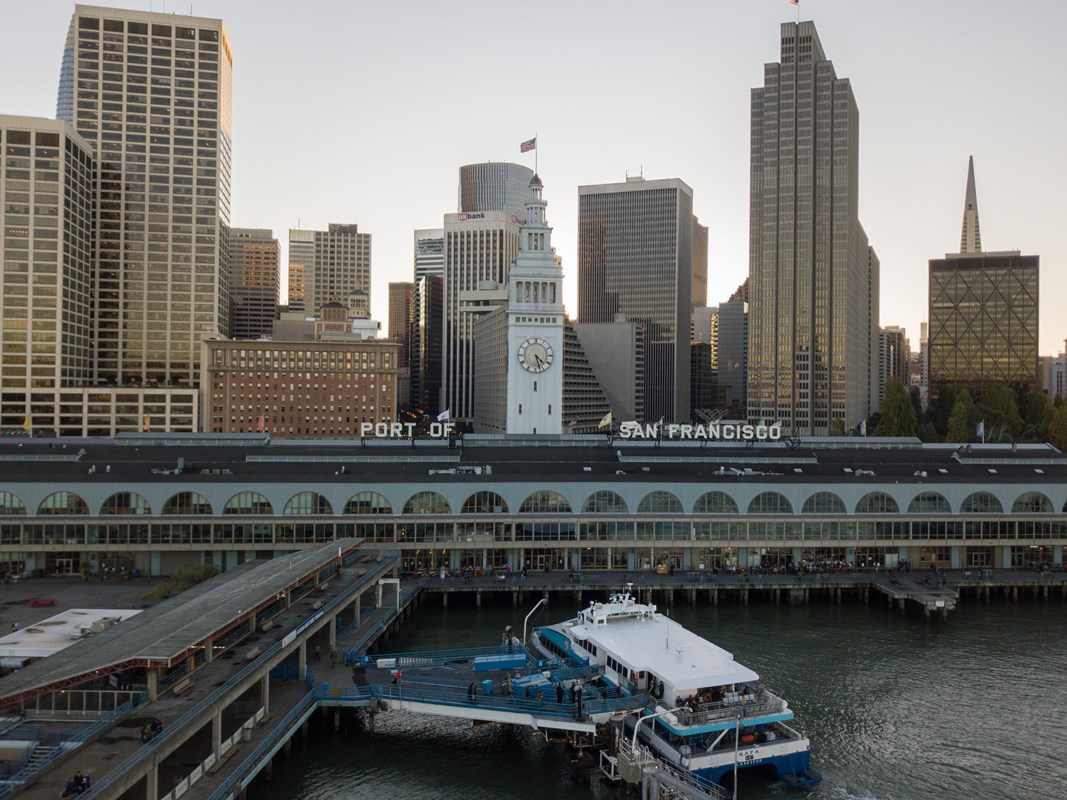
Golden Gate Ferry began service in the early 1970s with the original M.V. Golden Gate and three monohull vessels. In the late 1990s and early 2000s, Golden Gate Ferry expanded with high-speed aluminum catamarans that serve the core Larkspur to San Francisco route. After several decades of service, as of late 2025, many of the District's vessels are at or beyond the end of their economic service life and must be replaced in order for Golden Gate Ferry to meet updated emissions regulations.
Over the next eight years, the District will be replacing its ferry fleet with new, high-speed, low-emission ferries sharing the same design specifications across all ferries. At their November meeting, the District Board of Directors approved a contract to build the first two vessels in this years-long replacement program.
The MV Liwa-class vessel design (rendering above) is a 500 passenger, high-speed catamaran expected to be in service in 2027 and represents a significant leap in efficiency and emission reduction compared to the existing fleet. The MV Liwa will bring an 80% reduction in emissions and require 30% less power due to an improved hull design while providing the same high-speed service our customers expect. In addition to the MV Liwa, the new ferry order will provide a replacement for the MV Del Norte with the same specifications of the MV Liwa. The MV Liwa and replacement for the MV Del Norte are the first two ferries of our future fleet, which will consist of seven or eight identical vessels providing a standardized experience across Golden Gate Ferry by 2033. See current and past fleet specs and history here >.
The depths in the Larkspur Channel must be maintained by periodic dredging in order for the vessels to be able to reach the Larkspur Ferry Terminal. The 13,000-foot channel is dredged periodically to maintain a depth of 13 feet. Shoaling (a process whereby the channel progressively fills with silt over time) occurs at an average rate of a half-foot per year.